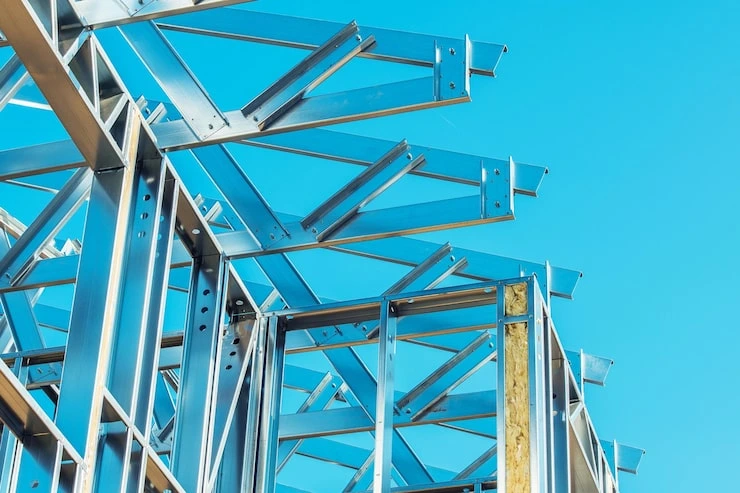
1. Lightweight Yet Strong
Lightweight and impressive strength are the key advantages of cold-formed steel framing. Steel structures made with CFS are easier to handle and transport compared to wood and concrete. Despite being lighter, the material has a high load-bearing capacity. It ensures structural integrity without compromising safety.
Strength and light weight are functional for large-scale construction projects where building materials must be lightweight. It reduces transportation and installation costs. Lighter weight also simplifies installation and reduces the load on foundations, benefiting foundation design and grading in Los Angeles‘s hilly terrains.
2. Precision & Consistency
Cold-formed steel framing requires manufacturing under strict quality control. The use of advanced machinery ensures accurate measurements and consistent performance. CFS maintains its dimensions for a long time, unlike natural construction materials like wood that warp, split, or shrink. Such consistency leads to faster and more reliable assembly when handling construction projects.
Precision components reduce on-site errors while limiting material wastage and contributing to safer structures. Engineers and architects can design the projects more confidently, knowing that the construction materials will deliver the exact results as intended. The material promotes efficiency in commercial building projects with tight deadlines and quality demands.
3: Faster Construction Time
Time is crucial in the construction industry. Due to its prefabricated nature, cold-formed steel framing helps complete construction projects on time. Manufacturers can manufacture the components off-site and deliver them to the site ready for assembly. Construction workers can install them quickly with minimal adjustments.
Since CFS is lightweight, fewer workers and machines are needed for installation. This is a key advantage for commercial contractors and developers aiming to meet deadlines with lower labor costs. Faster construction also means that the building can accommodate occupants sooner, providing earlier returns on investment. In cities like Los Angeles, where demand for housing and infrastructure is booming, this advantage can streamline development and meet the growing demand.
4: Corrosion Resistance & Durability
Durability is another crucial characteristic of cold-formed steel. For decades, the galvanization and protective coatings on CFS components have resisted corrosion and maintained structural integrity. Thus, they are far more durable than untreated steel or traditional wood framing. Durability also ensures fewer maintenance costs and extends the steel structure’s overall lifespan. In areas prone to extreme weather and moisture, corrosion resistance becomes an essential feature for builders. Unlike wood, CFS does not rot, warp, or decay, ensuring long-term value in construction projects.
5: Fire, Pest & Mold Resistance
Steel is non-combustible, providing natural resistance against fire. Additionally, it is immune to pests like rodents and termites that commonly damage wood structures in Los Angeles. CFS is also resistant to mold growth due to its property of not absorbing moisture. Together, these features make safer structures with lower repair and replacement needs over time. Since safety and resilience are essential in the construction industry, these key advantages set CFS apart from other building materials.
6: Design Flexibility
Cold-formed steel has an impressive design flexibility that enables architects to create innovative designs without structural limitations. Its high strength and light weight benefit through longer spans and creative architecture. Designers can use the material to develop both modern and traditional aesthetics. Because of their high adaptability, these frames are compatible with other construction materials as well, such as wood, glass, and concrete.
Design flexibility is one of the most compelling reasons to use CFS, especially for developers seeking versatile solutions in the construction industry.
7: Cost Efficiency
Cost efficiency is one of the most important factors when choosing building materials. CFS offers long-term savings through reduced labor, lower maintenance needs, and faster construction times. While initial costs may be higher than wood, it proves to be more economical in the long run. Since regions like Los Angeles have high construction activities, the savings can be substantial for commercial developers.
Common Misconceptions About CFS
Despite its popularity, cold-formed steel has a few misconceptions in the construction industry. Some of them are the following:
CFS is for commercial construction only
Many believe that CFS is limited to large-scale commercial construction. In reality, it works equally well for residential buildings, offering durability and safety in both sectors. Homeowners increasingly choose CFS for sustainable, energy-efficient, and long-lasting homes, proving its versatility extends beyond commercial buildings.
CFS is not as durable as concrete
Some assume that concrete is stronger than steel. However, CFS offers long-term structural integrity that surpasses traditional concrete and wood when appropriately designed. Protective coatings and galvanization further enhance durability, making CFS exceptionally resistant to harsh climates, moisture, and corrosion.
CFS is difficult to work with
A misconception exists that CFS is difficult to handle on-site. On the contrary, it is light in weight, and its precise design makes it easier to install than many other construction materials. Prefabricated components reduce labor needs, minimize waste, and simplify construction processes, making them highly practical for both residential and commercial projects.
CFS lacks design flexibility
Some believe that steel has limited creativity. However, CFS provides excellent design adaptability, enabling innovative architectures with other building materials like wood or glass. Engineers appreciate its ability to achieve complex geometries, longer life spans, and open layouts while maintaining integrity.
While the initial costs may be higher, the long-term cost-efficiency, reduced maintenance needs, and safety benefits make CFS more economical over the building’s life. Insurance savings, faster construction, and reduced repair needs contribute to the material’s overall affordability.
Conclusion
Cold-formed steel has drastically helped the construction industry overcome modern building challenges. With its unique balance of lightweightness, strength, precision, corrosion resistance, pest and fire protection, design flexibility, cost-efficiency, and sustainability, CFS helps build safer structures with long-term value.
Whether you are a concrete contractor in Los Angeles or handle retaining walls in Los Angeles, integrating CFS into your approach can enhance safety, efficiency, and durability. By understanding the key advantages of cold-formed steel, you can make more intelligent, more sustainable choices for the future.