Contact Us
18717 Parthenia St #10,
Northridge, CA 91324, United States

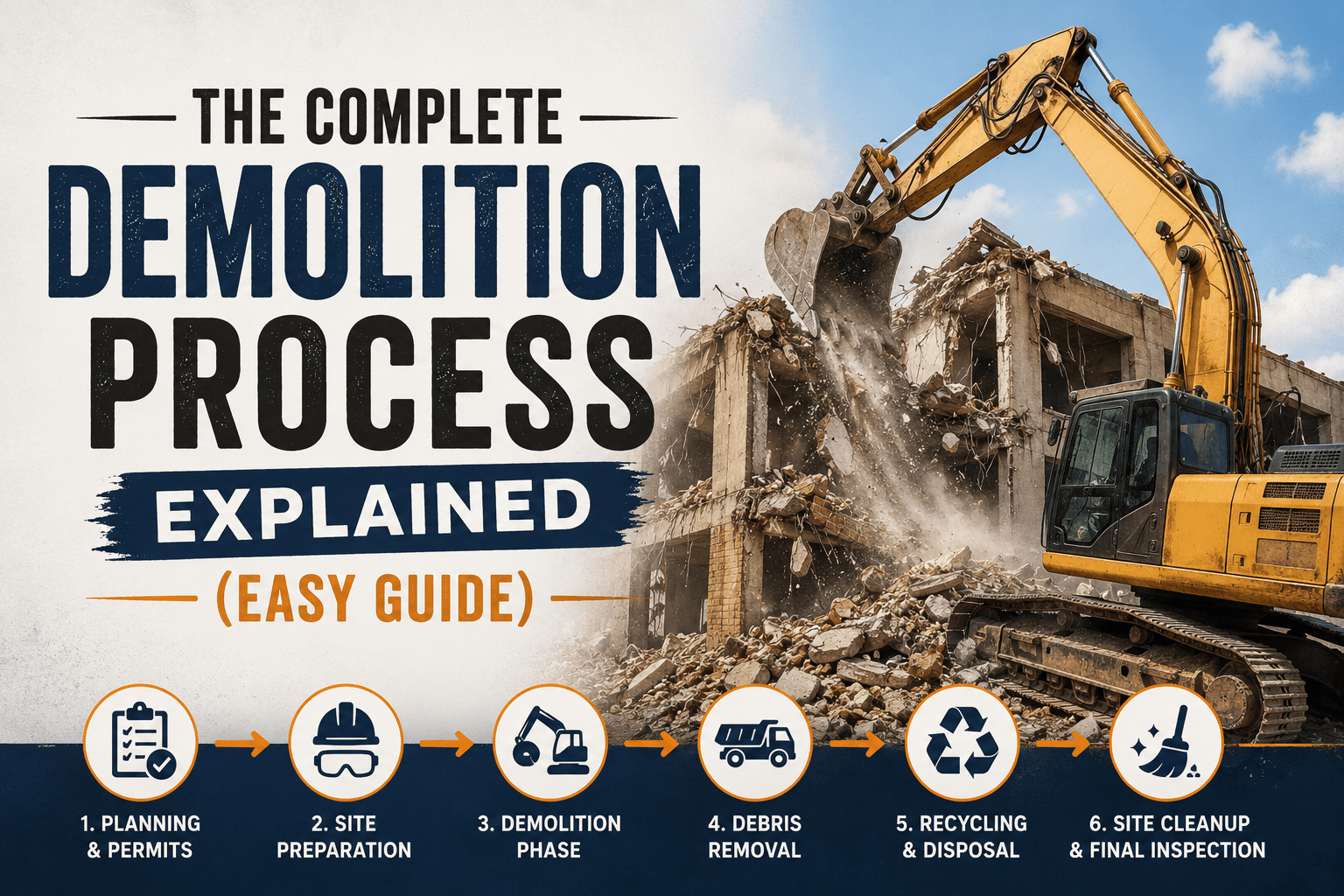
The demolition process is the structured, regulated sequence used to take down a building safely and legally. It runs from engineering survey and permits through utility shut-off, hazardous material removal, controlled teardown, and final site cleanup. Federal OSHA rules govern most of it, local permits cover the rest, and every step exists to protect workers, neighbours, and the environment.
This guide walks through each phase, the four demolition methods crews actually use, and the safety measures that decide whether a job stays on schedule. Whether it’s a small interior strip-out or a full building demolition, the bones of every demolition project look the same.
Demolition is the controlled dismantling of a structure under a written plan and federal safety requirements. It is not just the act of tearing something down. Done right, it is a regulated sequence that opens with a thorough survey and closes with a cleared, inspection-ready demolition site.
The legal backbone in the US is OSHA 29 CFR 1926 Subpart T. The regulation reads, “Prior to permitting employees to start demolition operations, an engineering survey shall be made, by a competent person, of the structure to determine the condition of the framing, floors, and walls, and the possibility of unplanned collapse of any portion of the structure.” That one line sets the OSHA standards baseline LACFCO follows on every building demolition.
Urban development is usually the loudest reason. Cities like Los Angeles redevelop aging parcels into mid-rise housing, and whatever sits there now has to go before any new construction goes up. So, here is why demolition is needed:
Picking the right demolition method comes down to size, location, and the surrounding conditions. Method selection is a key aspect of any plan. Get it right, and the surrounding community barely notices the work.
Hand-tool work for small structures and specific interior demolition tasks where heavy machinery would not fit.
The everyday method in most urban environments, and the workhorse approach across nearly all of LACFCO’s demolition services, including full demolition and exterior demolition.
Reserved for tall buildings on lots big enough to absorb the dust cloud and exclusion zones. Controlled implosion is rare in residential Los Angeles, and the wrecking ball has mostly been retired in favor of high-reach excavators.
Only the parts that need to come out come out. The rest stays in service, which makes this the standard approach for tenant fit-outs and interior renovations.
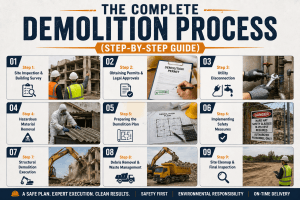
Below is the nine-step sequence most demolition teams follow on a standard commercial job.
A competent person walks the structure and documents the framing, the load paths, and the adjacent risks. Proper planning starts here, not later. According to OSHA, the engineering survey requirement under 1926.850(a) accounts for up to three-fourths of citations on a demolition worksite, which means this single step does more than any other to identify potential hazards and protect workers.
Local authorities sign off on the necessary permits after they review the plan against current building codes. The permitting process is what enforces regulatory compliance on a job. Skip it, and you collect stop-work orders and fines instead of a finished site.
Electricity, gas, water, sewer, and steam all get shut off and capped outside the building line before demolition work begins. Utility providers and utility companies get advance notice, and the crew confirms each line is dead before anyone goes near a wall.
Asbestos, lead paint, mercury switches, and any stored chemicals come out first. Licensed abatement crews remove hazardous materials under strict compliance with EPA and state hazardous waste disposal rules.
The detailed demolition plan specifies the demolition method, the demolition equipment list, the sequencing, and the timeline. It names the competent person on site, establishes exclusion zones, and ties every action to OSHA safety protocols.
Worker safety controls are put in place before the first wall moves. That includes personal protective equipment, perimeter fencing, sidewalk sheds at any pedestrian edge, and water suppression to control dust. Site security runs around the clock. Regular site inspections catch the small problems before they grow.
Specialized equipment, hand tools, or controlled charges follow whatever the plan calls for. Skilled operators work top-down on multi-story structures and keep an eye out for unexpected loads, residual stress, and debris paths that shift mid-job.
Material gets sorted right on site. Steel, concrete, wood, and gypsum each go to their own stream. Recyclable material is diverted from landfill, and debris hauling runs under environmental regulations on a schedule that does not strangle nearby traffic.
The ground gets leveled, the remaining structure (where any stays) gets secured, and inspectors confirm the work meets environmental considerations and safety requirements. Once the site clears, the next phase begins, whether that means foundation work, grading, or a fresh build by a concrete contractor in Los Angeles.
Quick reference for planning meetings.
| Step | Process Stage | Key Activities | Purpose |
| 1 | Survey & Inspection | Structural analysis, risk assessment | Ensure safety & planning |
| 2 | Permits & Approvals | Legal permissions, documentation | Compliance with laws |
| 3 | Utility Disconnection | Shut off gas, water, and electricity | Prevent accidents |
| 4 | Hazard Removal | Remove asbestos and toxic materials | Protect health |
| 5 | Planning | Select method, tools, and schedule | Efficient execution |
| 6 | Safety Setup | PPE, barriers, dust control | Worker & public safety |
| 7 | Demolition | Structure dismantling | Core operation |
| 8 | Waste Management | Recycling, debris removal | Environmental care |
| 9 | Final Cleanup | Site clearing, inspection | Ready for the next phase |
Even tightly run demolition activities run into obstacles. Crews that finish on time are the ones who planned for the things that go sideways, not just the things that go right. Minimizing disruption to neighbors stays a top priority through every phase.
The demolition process comprises nine sequential steps, four demolition methods, and one rule: planning protects everything that follows. Each phase exists for a reason, and shortcutting any of them shows up later as cost, delay, or risk to operational excellence.
If you are planning demolition in Los Angeles or coordinating concrete demolition in Los Angeles for a bigger project, LACFCO delivers full demolition solutions backed by the survey, the permits, and the method selection your job actually needs. Talk to the LACFCO team early. The rest moves faster when you do.
