Contact Us
18717 Parthenia St #10,
Northridge, CA 91324, United States

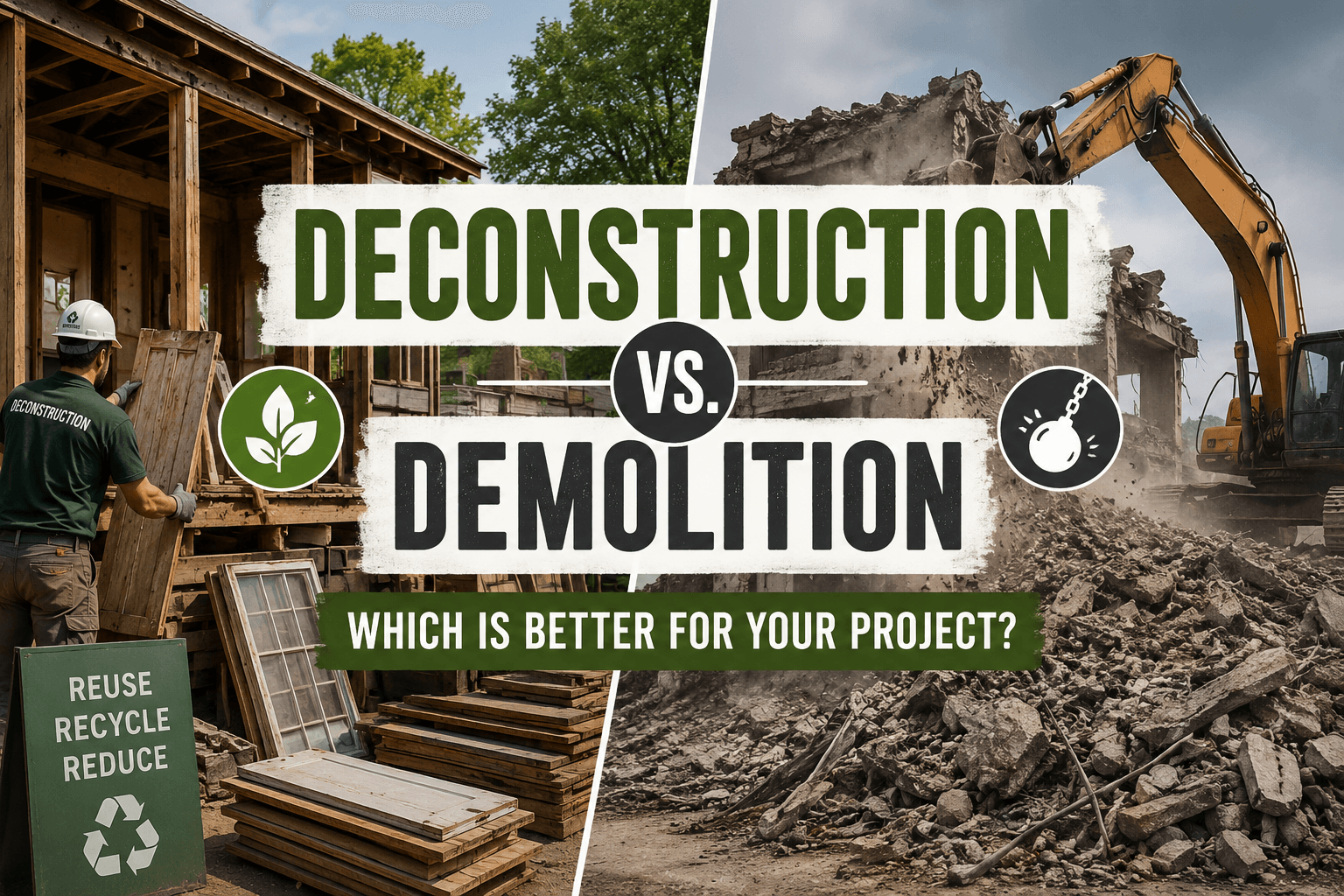
Deconstruction and demolition both bring structures down but they serve different goals, carry different costs, and leave very different sites behind. Deconstruction vs demolition isn’t just a terminology difference: one method recovers up to 90% of a building’s materials for reuse; the other clears a site in days but sends most of that material to a landfill.
Now, which is right depends on your timeline; budget; the building’s salvage value; and your environmental impact targets. This guide covers how each method works, where one outperforms the other, and the cost, waste, and construction industry trade-offs that should drive the decision.
Traditional demolition uses mechanical force to bring a structure down quickly. The primary goal is site clearance, not salvage. According to the U.S. EPA, 600 million tons of construction and demolition materials were sent to landfills in 2018, which is twice the municipal solid waste generated that year. That figure reflects how much demolition prioritizes speed over material recovery.
The process typically wraps in three to four days, making demolition the default when schedules are tight.
For demolition in Los Angeles, structural conditions, permit requirements, and neighboring properties all affect which equipment and methods are permitted on-site.
The deconstruction process works in reverse, methodically dismantling a building by hand to recover materials before they’re lost. Workers remove components selectively: windows, doors, lumber, flooring, and fixtures are extracted intact and sorted for reuse, recycling, or donation. As Felix Heisel, assistant professor and director of the Circular Construction Lab at Cornell University, put it: “You see a potential reactivation of the materials into a marketplace, and with that a second life in a new application.”
This approach can divert 75-90% of building materials from landfills. Commonly recovered items include hardwood flooring, old-growth lumber, cabinets, brick, sinks, tubs, and architectural details with strong resale value.
The gap comes down to three tensions: speed vs. sustainability, upfront cost vs. long-term financial return, and waste generation vs. material recovery. Deconstruction takes four to six weeks; demolition clears a site in days. The environmental impact gap is equally wide. Traditional demolition generates enormous landfill waste and higher greenhouse gas emissions, while selective deconstruction keeps most materials in circulation.
| Feature | Deconstruction | Demolition |
| Definition | Careful dismantling of the structure | Complete destruction of the structure |
| Speed | Slow | Fast |
| Cost | Higher upfront, savings from resale | Lower upfront |
| Environmental Impact | Eco-friendly, low waste | High waste generation |
| Material Recovery | High (reuse and recycle) | Low |
| Equipment Used | Hand tools, labor-intensive | Heavy machinery, explosives |
| Best For | Salvage and sustainability projects | Quick site clearance |
Deconstruction reduces landfill waste at scale. When 75 to 90% of building materials are diverted, debris volume drops sharply, cutting greenhouse gas emissions from waste transport and reducing demand for new natural resources in construction.
Salvage resale—old-growth wood, antique fixtures, masonry, cabinetry—offsets higher labor costs. Tipping fees decrease when most materials are diverted. Property owners may also qualify for tax benefits: donations of salvaged materials are deductible at fair market value, with the deduction carried forward up to five years.
Deconstruction creates economic opportunities. According to the REI Report, as stated by the United States Environmental Protection Agency, the recycling industry supported over 681,000 jobs in 2012, and labor-intensive dismantling expands that pipeline by feeding reusable materials back into local markets.
Demolition compresses weeks of work into days. For property owners working against a construction start date, that timeline difference is decisive.
Lower labor costs and shorter duration make demolition more affordable upfront when salvage value is minimal, and site clearance is the only goal.
Structurally compromised, contaminated, or partially collapsed buildings can’t be deconstructed safely. Demolition isn’t just the faster option in those cases; it’s the only responsible one.
Choosing deconstruction means accepting real constraints:
Demolition’s speed comes with compounding costs:
Deconstruction fits your project when:
Demolition is the right method when:
Excavation contractors and demolition teams assess these conditions before work begins. Structural or contamination issues aren’t always visible from the outside.
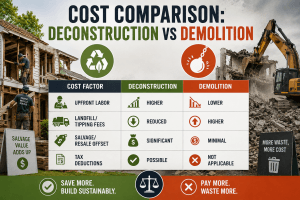
| Cost Factor | Deconstruction | Demolition |
| Upfront labor | Higher | Lower |
| Landfill/tipping fees | Reduced | Higher |
| Salvage/resale offset | Significant | Minimal |
| Tax deductions | Possible | Not applicable |
In the short term, demolition costs less. Over the full project lifecycle, when salvage resale, reduced tipping fees, and tax benefits are factored in, deconstruction often delivers better financial returns for structures with recoverable building materials.
Most misconceptions come from treating both methods as interchangeable; they’re not.
| Myth | Reality |
| Deconstruction is always more expensive | Salvage value and tipping fee savings frequently offset higher labor costs |
| Demolition is always bad for the environment | Proper debris sorting reduces its footprint, though not to deconstruction levels |
| Both methods are interchangeable | Unsafe structures can’t be deconstructed; historic buildings with valuable materials shouldn’t be demolished |
| Deconstruction only works on old buildings | Newer builds often contain quality lumber, fixtures, and systems with real resale value |
That last point is underappreciated. A concrete contractor in Los Angeles regularly encounters recent construction with salvageable steel, cabinetry, and mechanical components. Choosing deconstruction for the right sections of a newer build can still deliver financial returns that demolition would forfeit entirely.
The deconstruction vs demolition decision comes down to project priorities: schedule, budget structure, material value, and sustainability goals. Demolition clears a site efficiently when speed and upfront cost are the primary drivers. Deconstruction recovers value from what’s already there, reduces waste, and supports green building goals when the structure and timeline allow.
LACFCO works with property owners across Southern California to evaluate both approaches before any equipment arrives. If you’re planning a teardown, contact LACFCO for a pre-demolition assessment. The right method is a decision worth making deliberately.
Yes. Selective deconstruction can recover high-value materials manually while demolition handles the remaining structure. LACFCO evaluates each project to identify where that hybrid approach makes both practical and financial sense.
Upfront, demolition costs less. Once salvage resale income, reduced tipping fees, and potential tax deductions for donated materials are accounted for, deconstruction frequently delivers a better long-term financial outcome for structures with recoverable building materials.
Deconstruction, by a significant margin. It diverts 75 to 90% of materials from landfills, reduces greenhouse gas emissions from waste transport, and keeps reusable materials in circulation rather than sending them to disposal.
Most can, but local regulations, site conditions, and contamination status all affect how demolition in Los Angeles is permitted. Structures near retaining walls in Los Angeles, CA or with complex foundations may require additional engineering review before work begins.
